I’ve been trying to keep the Molloy Consulting blog a bit more up to date this year, and one of the topics I keep coming back to in conversations is AI. Rather than make broad predictions about where it’s all going, I thought it would be more useful to set down some practical reflections on how I’m actually using it in my workflow, where it helps, and where I think the limits still are.
Public lighting design is, at its core, a technical discipline. The backbone of any scheme is still the lighting calculation, whether that’s carried out in Lighting Reality or Dialux. It involves understanding BS EN 13201 and related guidance, selecting appropriate lighting classes, managing glare and uniformity, applying correct maintenance factors, and aligning everything with the relevant local authority specification. It also requires real coordination with civil layouts, ESB interfaces and planning constraints.
AI cannot calculate compliant road lighting layouts. It cannot meaningfully interpret layered CAD drawings and determine appropriate column spacing. It cannot take responsibility for design risk or stand over a scheme if it is challenged. That remains firmly in the domain of the designer.
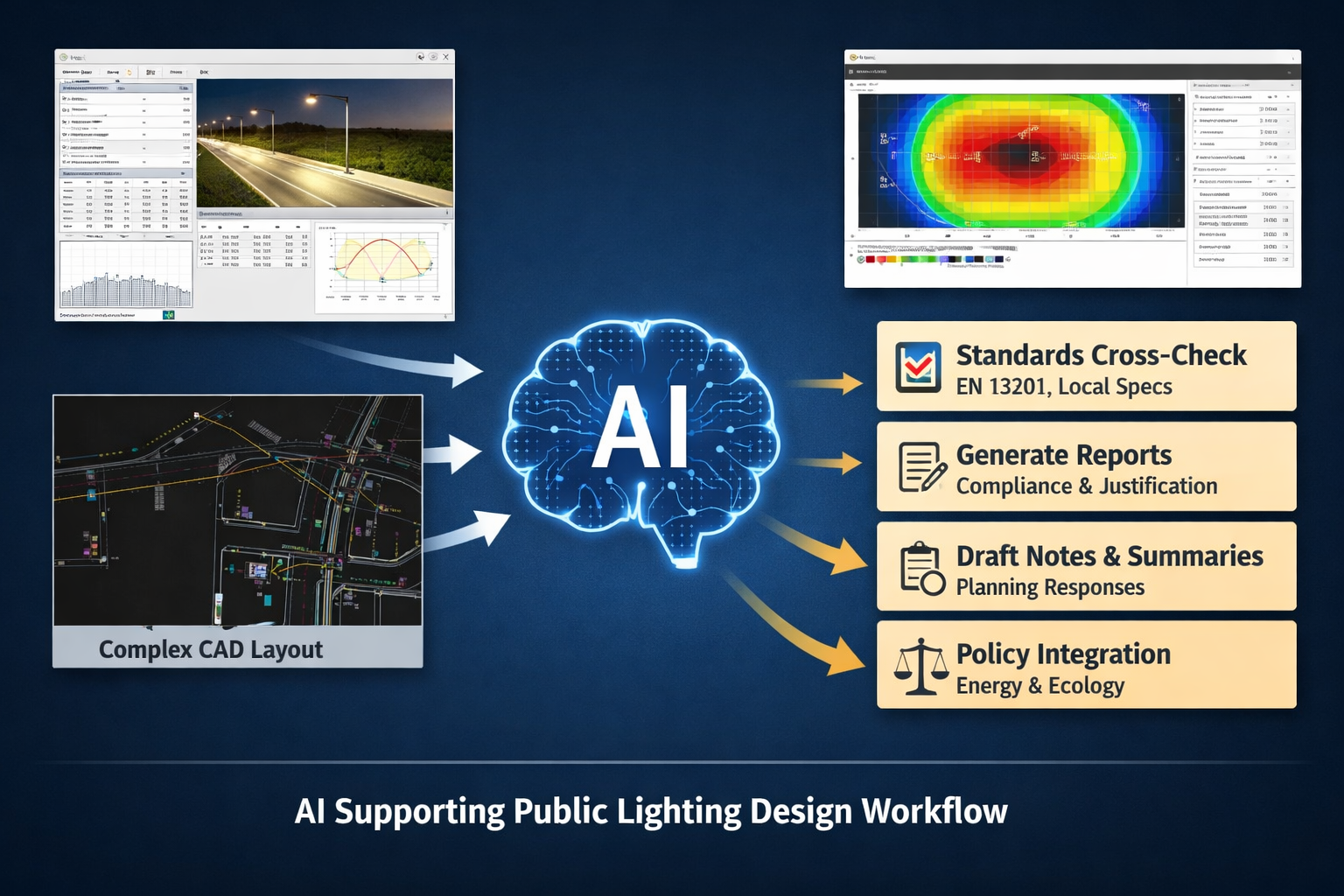
Where it does have value is in supporting the written and organisational side of the work. In my own practice, I’ve found it helpful for:
- Cross-referencing standards and pulling together relevant clauses quickly
- Structuring reports so they read more clearly and logically
- Refining draft planning statements and technical notes
- Sense-checking explanations to ensure they are coherent and proportionate
Used in that way, it acts as an efficiency tool. It supports communication rather than replacing engineering judgement.
That distinction is important because lighting design is not just about compliance; it is about context. Decisions around trimming versus dimming, balancing ecological mitigation against uniformity targets, or anticipating how a particular public lighting section will review a submission all rely on experience. They come from years of working within the Irish public lighting system and understanding how schemes are assessed in practice. AI can summarise what you tell it, but it does not possess that lived professional context.
The area where I think we may see unintended consequences is documentation. AI makes it remarkably easy to generate long, polished reports. Entire sections can be produced in seconds, complete with references to standards and guidance documents. On the surface, that seems efficient. The risk, however, is not that the content is wrong; it is that there is simply too much of it.
If lighting statements that once ran to fifteen pages start coming in at forty pages because software can produce them instantly, we may enter a period of content inflation. Planning authorities, consulting engineers and local authority reviewers already work under significant time pressure. Increasing the volume of documentation does not necessarily increase clarity. In fact, it may reduce it.
There is a real possibility that, for a time at least, we end up drowning in well-written but excessive material. Generic commentary, repeated references to standards, and overly elaborate explanations could begin to obscure the actual engineering decisions that matter. The signal-to-noise ratio drops, and important design rationale gets buried in text that sounds impressive but adds little.
That is something I am very conscious of in my own workflow. My aim is not to use AI to produce more content, but to improve the quality and efficiency of what I already produce. If it helps tighten a paragraph, clarify a technical explanation or ensure a report is well structured, that is constructive. If it simply encourages me to pad out a submission because I can, that is not.
As AI becomes more common across engineering and planning, I suspect restraint will become increasingly important. The ability to submit concise, focused documentation — where each section serves a clear purpose and respects the reader’s time — may well become a differentiator. In that sense, professional judgement will matter more, not less.